
Background
A public backend talk from Nintendo is a rare thing. At AWS Summit Japan 2026, session CDN221 “The Technology Behind GameChat” (「ゲームチャットを支える技術」) walked through the service design behind GameChat, a built-in feature of Nintendo Switch 2. The speakers came from the System Development Department at Nintendo Systems Co., Ltd. (ニンテンドーシステムズ株式会社). That affiliation itself is worth noting: Nintendo Systems is not Nintendo proper but a joint venture Nintendo and DeNA founded in 2023, mainly responsible for developing the systems behind Nintendo’s online services.
The session showed no particularly novel technology. It ran on components every attendee already knows: WebRTC, EC2, Fargate, DynamoDB, SQS, Terraform, OpenTelemetry. Yet nearly every LLM rated it the most information-dense session of the event. Below I recap the talk, focusing on three engineering decisions that lock cleanly into each other.
What Is GameChat?
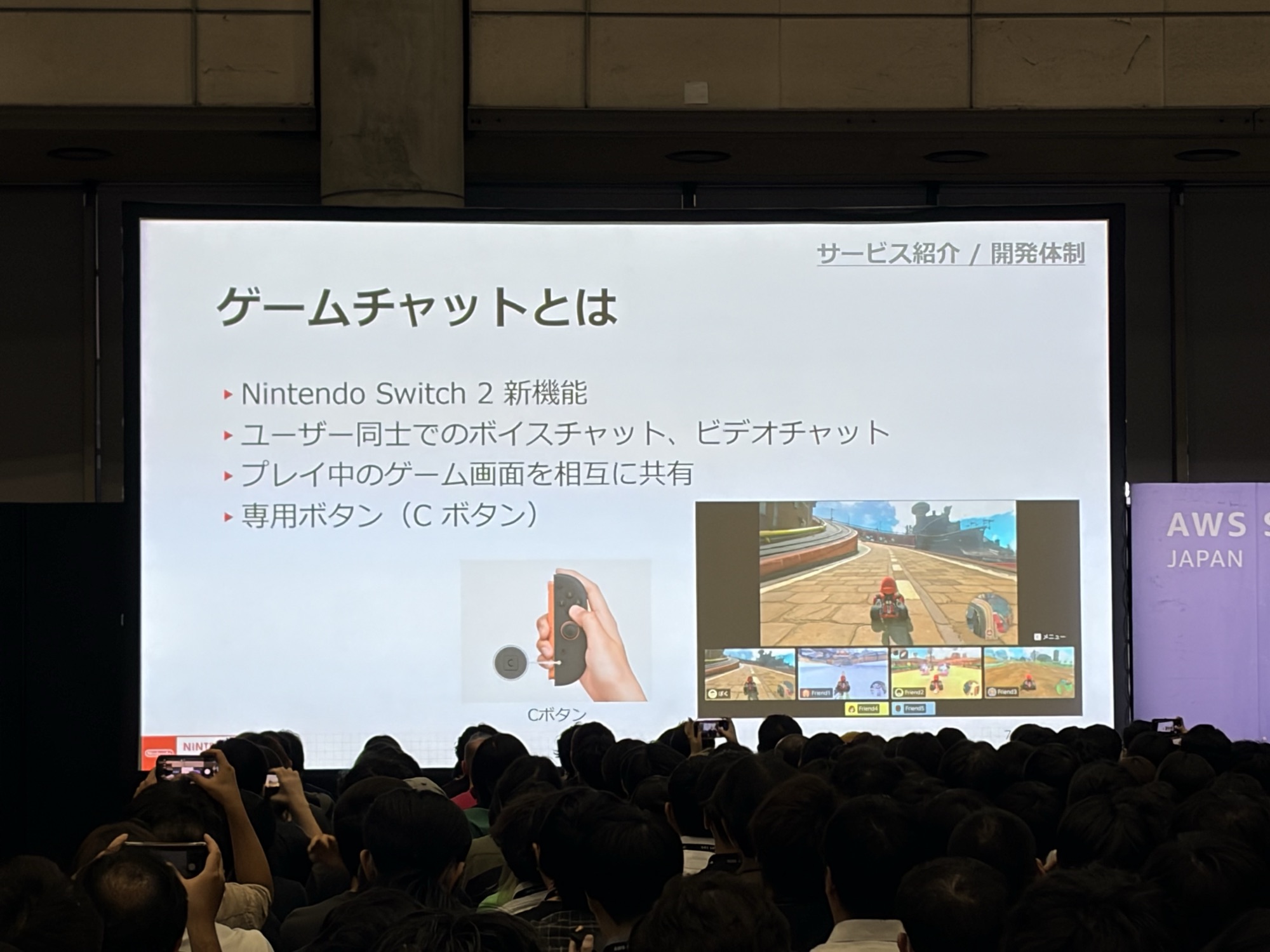
GameChat is a built-in Nintendo Switch 2 feature for real-time voice and video communication between users, plus game screen sharing. The new C Button on Joy-Con 2 signals a system-level entry point: a player can trigger a chat in the middle of any game, so both the backend and the client have to treat “enter with low latency” as a baseline assumption.
The most important detail is that screen sharing is a default capability. GameChat is not a lightweight voice channel; it is a real-time communication system handling voice, camera video, and game screen sharing at the same time. On a console already running a game, CPU/GPU, memory, hardware encoders, and uplink bandwidth are all finite. The backend has to offload complexity from the client from day one.
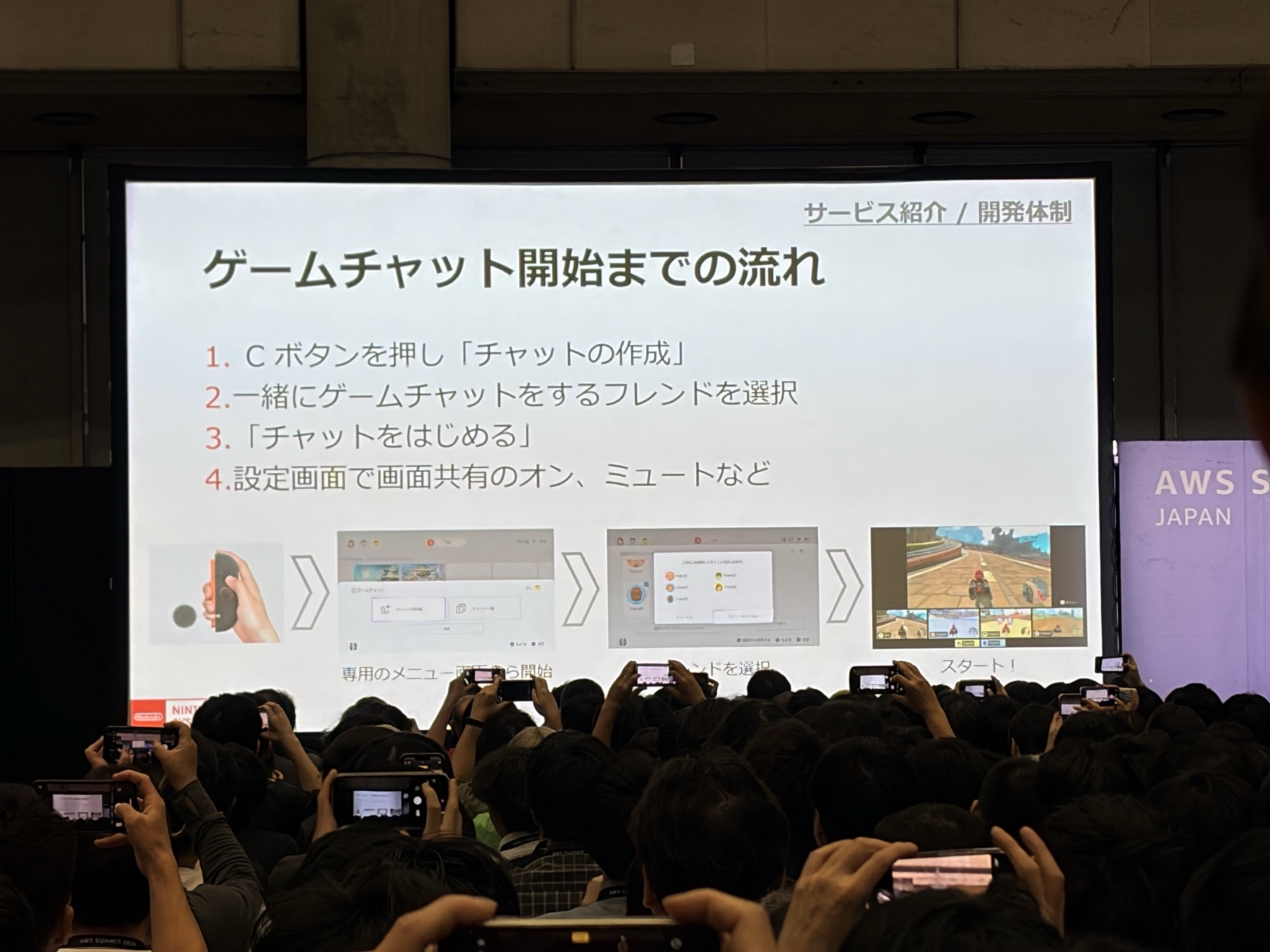
The user flow looks simple: press the C Button, pick friends, start the chat, then set up screen sharing and mute. From the backend’s perspective, each step maps to a set of service calls.
Pressing the button triggers session bootstrap, auth token checks or renewal, and chat context initialization. Picking friends requires the friend list and presence data. Starting the chat is where invitations, room creation, media server assignment, and WebRTC connection setup actually begin. The final screen sharing configuration shapes the publisher/subscriber relationships on the SFU side.
The flow also implies an important structure: a chat is not a fully peer-to-peer mesh. The initiator creates a room and invites the other members in. The state machine, the consistency problems, and the additional-invite logic that follow are all built around this room concept.
Product Constraints: Real-Time Communication, 12-Person Rooms, Running Alongside a Game
GameChat’s service requirements are real-time video and audio, up to 12 participants per GameChat group, and operation in parallel with gameplay. The number 12 matters.
With a P2P mesh, every client in a 12-person room uploads media streams to the other 11. For home networks, NAT environments, and the Switch 2’s encoding budget, that is essentially infeasible. Even voice-only mesh connection management bloats quickly; once game screen sharing joins in, P2P stops being realistic.
“Running alongside a game” is the hardest product constraint in this system. A normal video conferencing app can claim foreground resources, but GameChat behaves more like a background real-time process embedded in the system layer. It cannot steal the resources a game needs for rendering and online play, so the server side has to carry more of the forwarding, selection, and state management work.
The session said GameChat uses WebRTC for real-time audio/video and emphasized UDP packet communication. That sounds simple, but the actual engineering is far more complex than “it uses WebRTC.”
WebRTC bundles a full media protocol stack: ICE, STUN, TURN, DTLS-SRTP, RTCP, congestion control, and more. More importantly, WebRTC does not define business signaling. How rooms get created, how invites are sent, how users authenticate, and how clients discover SFU endpoints are all left for the application to implement.
On an embedded game device like the Switch 2, WebRTC is also bound by hardware codecs, system resource isolation, NAT traversal, and network quality. WebRTC does not eliminate backend design. It standardizes media transport and leaves the room, auth, and scheduling problems to the server.


P2P has the lowest theoretical latency for a two-person call, but for a multi-person GameChat the issue is not the theoretical shortest path. It is stability and client load.
P2P mesh complexity is $O(N^2)$. A 12-person room has $C(12,2)=66$ total connections, and every client maintains multiple uplinks. An SFU collapses each client’s uplink into a single media stream that the server selectively forwards to the other members. It trades a bit of server-relay latency for far more controllable bandwidth, load, and failure handling.
Real networks add NAT hole-punching failures, TURN fallback, unpredictable cross-border links, and the weak-network member dragging the whole room down. For a system like Nintendo’s that has to run reliably across home networks worldwide, SFU is the more practical choice.
System Architecture: Splitting the Control Plane from the Media Plane
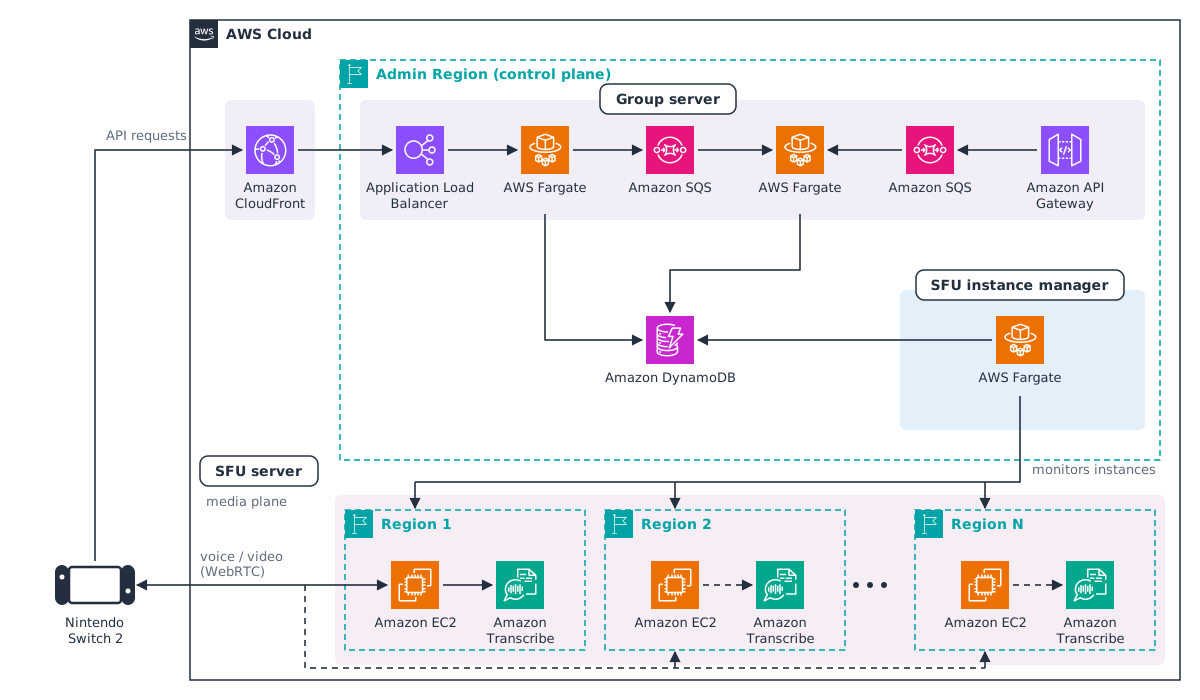
The architecture diagram splits the system into two layers.
The control plane is concentrated in the Admin Region. CloudFront, ALB, Fargate, SQS, API Gateway, and DynamoDB together form the group server, the async workers, the SFU instance manager, and the state store. This is where rooms, invitations, authentication, state sync, and instance discovery live.
The media plane is deployed across multiple regions. Each region runs SFU servers on EC2 plus Amazon Transcribe. The SFUs handle the actual WebRTC audio/video connections and forwarding. This layering matters: low-latency media paths need to sit near users, while making control-plane state multi-region as well would pull in data synchronization, conflict resolution, and much harder failure modes.
Re-reading the diagram by function, the services fall into three groups.
The first is the group server (グループサーバー). It handles room creation, invitations, membership, the auth webhook, and DynamoDB updates. It is the main entry point for business state.
The second is the SFU instance manager (SFU インスタンスマネージャー). It monitors the state of SFU instances in every region, centrally manages connection counts and load information, and writes them to DynamoDB for the group server to use when picking connection targets.
The third is the SFU server (SFU サーバー). It runs on EC2, handles WebRTC connections and media forwarding, and reports connection events back to the control plane. EC2 rather than Fargate is a natural fit here: UDP, high PPS, long-lived connections, instance-level network performance, and stateful rooms all favor EC2.

The session contrasted a single region at 500ms with multi-region at 50ms, while explicitly noting that the map and the latencies were illustrative. These numbers should not be read as measurements. The real point is that real-time calls are extremely sensitive to RTT thresholds.
Voice call quality does not degrade linearly. Below 50ms is barely noticeable, 50 to 150ms is mostly tolerable, past 150ms the rhythm of the conversation visibly breaks, and past 300ms both sides start “waiting for the other to finish.” In GameChat’s scenario, talking while playing a game, latency is amplified even further.
The value of multi-region SFU is connecting users to a nearby media node and pushing cross-region complexity onto the server side. The diagrams did not say whether the SFUs cascade between themselves, and the specific regions were never disclosed. That is one information gap the session left open.
Nintendo Systems runs regions selectively: SFU servers are multi-region, while the group server and the SFU instance manager stay single-region.
This is textbook control plane / data plane separation. The media plane directly determines call latency, so it has to sit near users. The control plane mainly handles room creation, joining, and state management, which are less latency-sensitive. Keeping the control plane in a single region avoids Global Tables, cross-region write conflicts, and strong-consistency coordination.
The cost is clear too. If the Admin Region fails outright, users worldwide may be unable to create or join GameChat sessions, though already-established media connections could keep running. The core of this trade-off: localize the media path, the highest-frequency, most experience-critical piece, and centralize the low-frequency, complex control state.
A client needs to know which SFU to connect to. That looks like service discovery, but it is more complicated than plain DNS or load balancing.
Picking an SFU has to weigh region latency, per-instance connection counts, CPU/bandwidth load, health status, and room affinity, all at once. If a room’s members scatter across multiple SFUs, the SFUs have to relay between themselves; if every member lands on a single SFU, remote users get worse latency.
At bottom, SFU discovery is a placement scheduler: picking the best media instance for a given user, in a given room, at a given moment.
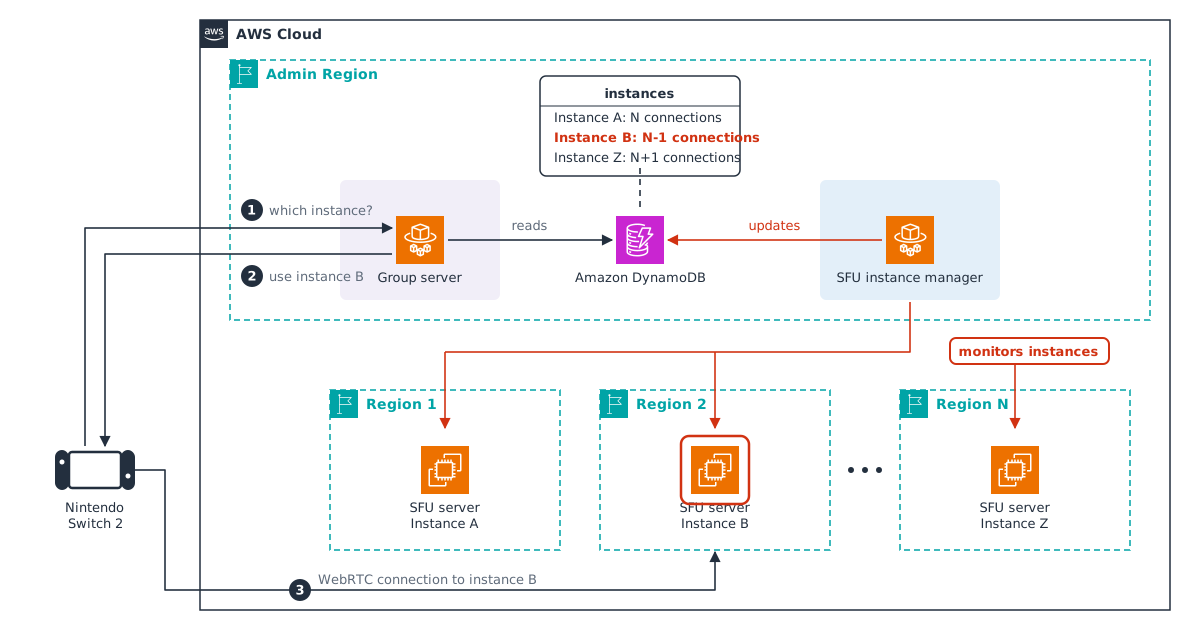
The solution: the SFU instance manager monitors every instance and writes information like connection counts into DynamoDB. The group server reads the same DynamoDB, picks a suitable instance, and returns the endpoint to the client.
This design has a plain but effective advantage: instead of bringing in Consul, etcd, ZooKeeper, or Cloud Map, it reuses the DynamoDB that already serves as the control plane’s state store. In a managed AWS environment, that is one less piece of infrastructure to operate.
The flip side: instance state is effectively eventually consistent. Connection counts realistically cannot be written to DynamoDB synchronously on every change, or write capacity and cost would spike. More plausibly, the manager keeps state in memory and flushes to DynamoDB periodically or by threshold. The load data the group server sees can lag by seconds, so retry and fallback after a failed client connection have to exist as well.
The Join Path: Authentication, Event Sync, and Critical-Path Isolation
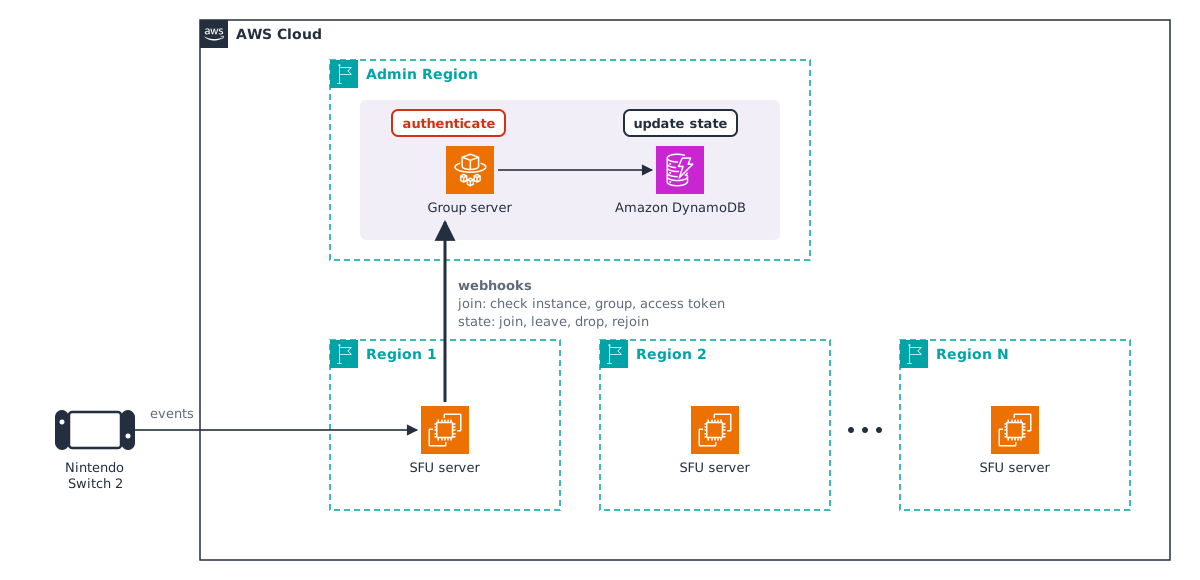
Joining a room requires three checks: is the user connected to the correct SFU instance, do they belong to the right group, and is the access token valid? User state changes, such as joining, leaving, momentary drops, and reconnects, also sync back to the group server and get written to DynamoDB.
This means the SFU is not the source of truth for business state. It handles media connections and events, but whether a user is allowed in and what the room’s current state is remain the job of the group server and DynamoDB.
This division shrinks the SFU’s blast radius. The SFU is exposed to public UDP and WebRTC ingress. As long as it holds no user tables, membership data, or auth secrets, business data and access control stay centralized in the control plane even when a media instance has problems.
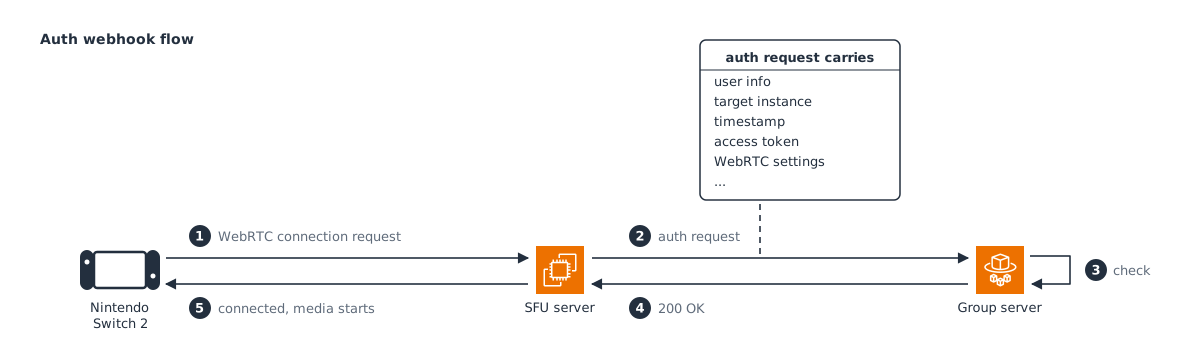
After the SFU receives a WebRTC connection request, it calls the group server through the auth webhook. The request carries user information, the target instance, a timestamp, the access token, and WebRTC settings. Only after the group server verifies it and returns 200 OK does the SFU complete the connection.
This resembles the usual media-server auth callback pattern: the SFU does not touch DynamoDB directly and does not embed full business auth, delegating the authorization decision to an external management server.
The cost is that the auth webhook sits on the join critical path. A cross-region user connects to a nearby SFU, but that SFU may still have to call back to the group server in the Admin Region to authenticate. For a low-frequency action like joining a room, a few hundred milliseconds is acceptable. For per-frame media forwarding, it would be fatal.
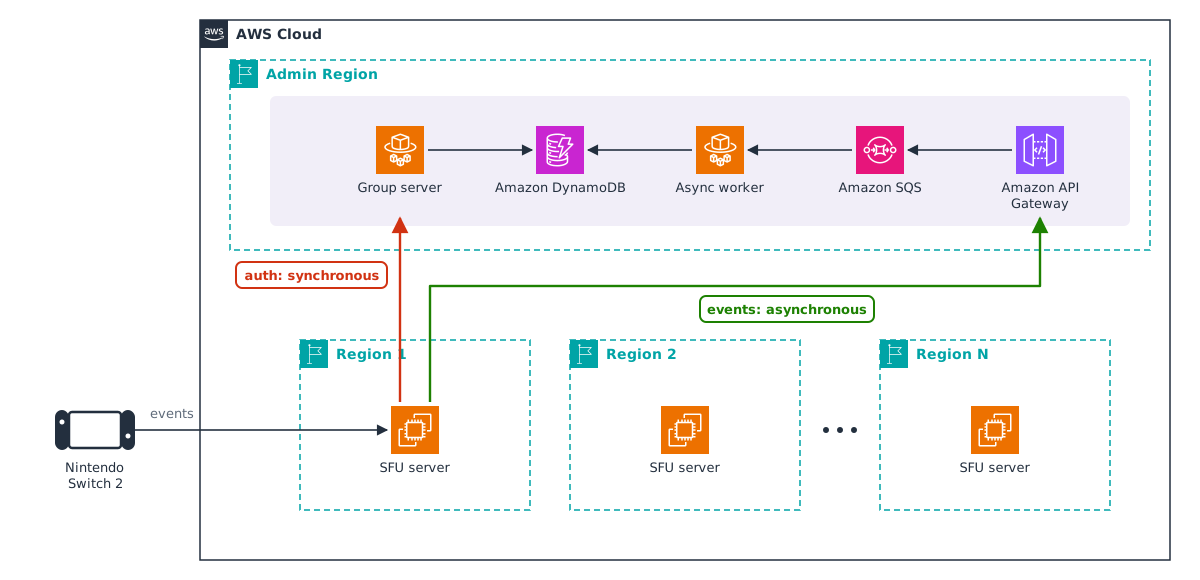
The session split webhooks into two categories.
The auth webhook is a synchronous path that directly affects the join experience. It should run on a low-latency, independently scaling group-server path.
The event webhook can be asynchronous. The SFU sends events to API Gateway, they flow into SQS, and independent workers update DynamoDB. Join, leave, drop, and reconnect events need to be synced eventually, but they do not have to block what the user is doing right now.
This separation is an important step in mature system design. Workloads with different SLAs cannot share one worker pool. Otherwise high-frequency async events crowd out synchronous auth resources, and the end result is a user pressing the C Button and never getting into chat.
Operations: Observability and Regional Modularity
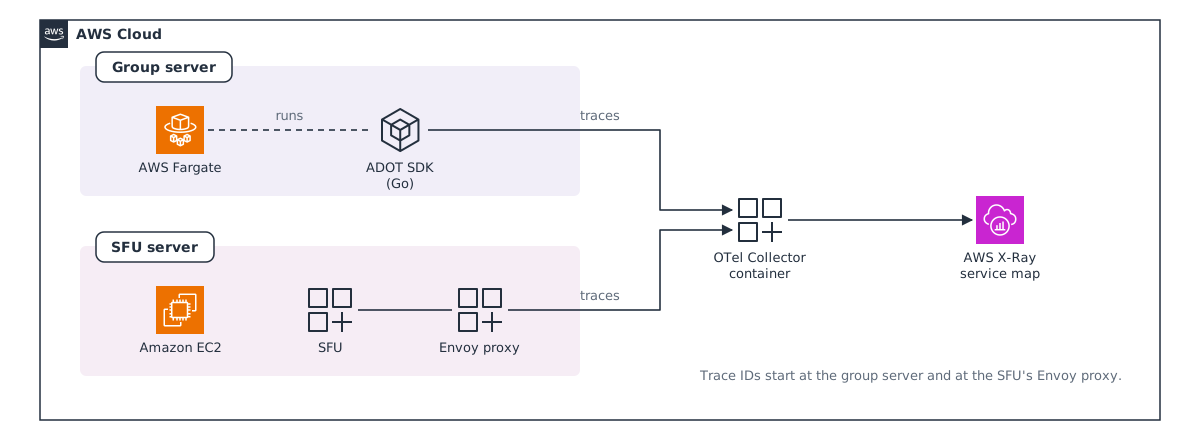
The observability section revealed a few stack details. The group server is written in Go and generates traces via the AWS Distro for OpenTelemetry SDK. On the SFU side, an Envoy proxy generates or propagates trace IDs, and an OtelCollector container collects them and ships them to AWS X-Ray.
The system does not bind directly to the X-Ray native SDK; it uses OpenTelemetry as the abstraction layer. X-Ray is only the current backend exporter. Switching to Tempo, Honeycomb, or Datadog later would in theory only require collector configuration changes.
Using Envoy on the SFU side is interesting too. The media server itself may be awkward to instrument, especially if it is an open-source SFU or an internal fork. Using an Envoy sidecar to intercept webhook HTTP traffic and inject traces is a way of adding observability from the outside.
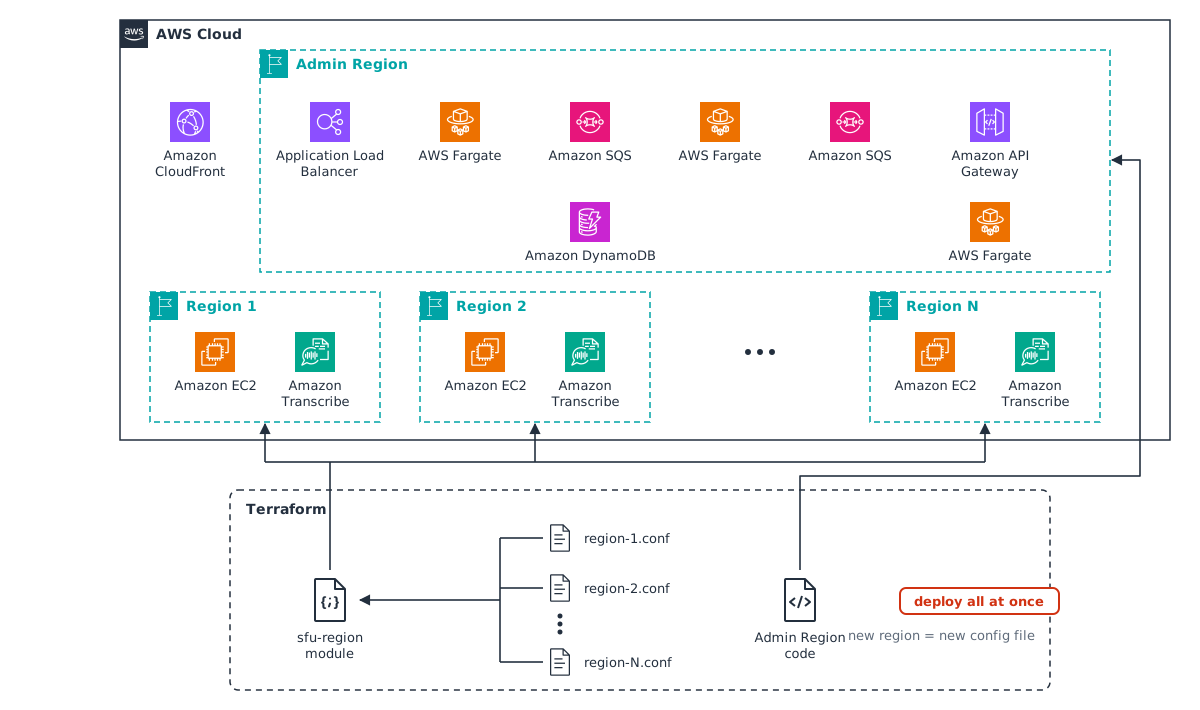
SFU regional resources are managed through a Terraform module. Inject a different config per region and you get the corresponding EC2, networking, and Transcribe resources.
The value is abstracting “the media-plane resource set for one region” into a repeatable deployment unit. When the business adds or removes regions, nobody has to copy-paste an entire infrastructure definition.
That said, the slide’s “respond immediately” (即座に対応) should not be read as “a new region is one terraform apply away.” Bringing a new region online also involves image replication, client region-list updates, instance manager configuration, monitoring and alerting, staged traffic cutover, and failure drills. Terraform solves provisioning, not the full go-live process.
DynamoDB Modeling: Cost, Query Patterns, and Denormalization
The second half moved into DynamoDB development examples: cost efficiency, use-case-driven design, denormalization, the GameChat start flow, state transitions and eventual consistency, and handling inconsistency in additional invites.
This is where the session’s real engineering density lives. The first half can be summarized as control plane / media plane separation. The second half asks a deeper question: once state lives in DynamoDB, how do you design read/write cost, consistency windows, and the UX state machine together?

DynamoDB is a key-value / wide-column managed database where partition keys, sort keys, and item size directly drive read and write cost. The session emphasized that writes deserve more attention than reads, and not only because of WCU itself: writes amplify through GSIs, Streams, and replication paths.
In a system with high-frequency state changes like GameChat, cost is not a parameter you tune after launch. Every join, leave, drop, and reconnect can produce a write. If the data model makes one state change touch multiple GSIs or multiple item rows, cost multiplies accordingly.
So DynamoDB cost efficiency is not as simple as “query less.” It comes from designing access patterns, item shapes, GSI counts, and consistency requirements together.

Nintendo Systems’ design steps: first build a provisional RDB-style data model, then design the APIs, list the use cases, extract the access patterns, and finally decide keys and facets.
Know how the system needs to read before designing how it stores. The RDB model maps out entities and relationships such as user, group, room, and invitation. When the design actually lands in DynamoDB, partition keys, sort keys, and facets get reverse-engineered from the query patterns.
This is the standard process Alex DeBrie recommends in The DynamoDB Book.

The session explained denormalization by keeping list data directly inside an item. In GameChat terms, you can read this as a room item holding the member list inline, possibly even including user IDs and display names.
Reading room state then takes a single GetItem or Query, with no join against a user table. The price: low-frequency events like a user renaming themselves need fan-out updates, or you accept short-term staleness.
For GameChat this trade-off makes sense. Rooms are short-lived, member-list reads are high-frequency, and renames are rare. Compressing the hot read path into a single read fits a real-time system’s cost and latency targets better than chasing full normalization.
The State Machine: From Reserved to Connected

The GameChat start flow can be modeled as a state machine spanning multiple systems: friend selection (フレンド選択), reserved (予約済み), authenticated (認証済み), connected (接続済み), notification sent (通知送信). It is not a simple backend enum. It strings together UI actions, the room state in DynamoDB, the SFU’s media connection facts, and the notification channel. Friend selection happens on the client; “reserved” means the control plane has recorded the chat intent; “authenticated” comes from the SFU webhook’s authorization result; “connected” should be driven by the actual WebRTC connection; and “notification sent” is an asynchronous side effect that can be deferred.
The “reserved” state is the critical one. Instead of creating a full media room up front, the system first records the chat intent in cheap control-plane storage. That way, SFU resources are not consumed while a user has only picked friends and the other side has not responded yet. A room state in DynamoDB is lightweight; a room on an EC2-hosted SFU is an expensive media resource. In other words, this is lazy resource allocation: commit the logical reservation first, and allocate physical resources only when a media connection is actually needed.
When the flow enters “connected,” the source of truth is no longer the client UI or DynamoDB itself but the SFU. The SFU notifies the group server that the connection completed, and the control plane writes that media-plane fact back into the state store. The session did not expand on one practical question: what counts as a completed WebRTC connection: finished SDP offer/answer, successful ICE, a completed DTLS handshake, or the first media frame? Each definition changes user wait time, failure retries, and state timeouts.
Notifications after the connection completes do not need to be bound to the initiator’s waiting path. The initiator needs fast feedback so they can land in the chat screen; that is the user-perceived path. The invitee does not know yet, so a notification a few seconds late is usually acceptable and can be retried on failure. This is the sync/async split again: not every step in the state machine matters equally. Only the parts that close the current user’s action loop need the short path.
When UI state, SFU events, DynamoDB state, and the notification channel are not one system, consistency stops being a database-internal detail and becomes a user-visible flow problem. What makes this part of the design valuable is that it decomposes “record intent first, confirm the media fact second, notify asynchronously last” into steps with different costs and different SLAs, so expensive resource allocation, media connection confirmation, and notification delivery never get squeezed into one synchronous path.
Consistency: Strong Reads Are Not a Magic Switch

The session showed a real problem: while the client is in the authenticated (認証済み) state, calling a certain API returns “API access unavailable” (API アクセス不可). The API is allowed only after the state reaches connected (接続済み).
At bottom this is a mismatch between the state the client perceives and the state the server sees. The UI may already make the user feel “in the chat” while the control plane still considers the room authenticated but not connected. Or DynamoDB already holds the connected write, but an eventually consistent read returns the old state.
There is no silver bullet. You can raise read consistency, make the UI wait for a stricter server-confirmed state, or loosen the API precondition so more operations are executable at the authenticated stage. Mature systems usually combine these rather than flipping every read to strongly consistent.

DynamoDB supports strongly consistent reads, which guarantee you read confirmed writes. It is the direct answer to many consistency problems, but it costs more and changes the read load distribution.
Strongly consistent reads are also not available everywhere. They mainly apply to base-table reads within a single region; GSIs remain eventually consistent. On a high-frequency read path, switching every read to strong both increases cost and can hide problems in the data model itself.
Strong reads should be a tool for the constraints that actually need them, not a switch you flip globally whenever state looks inconsistent.
Nintendo Systems explicitly said that this time they tolerated eventual consistency through design work, so they did not adopt strongly consistent reads.
This is where the session’s judgment shows most clearly. The most direct fix is switching reads to strongly consistent, which relieves the problem immediately but doubles cost and nudges you toward using DynamoDB like an RDBMS. The more mature approach analyzes the concrete access patterns: which operations truly need strong consistency, and which can avoid read-modify-write through the business flow.
This is not merely about saving money. It is the precondition for keeping DynamoDB’s cost and scalability advantages.

This slide was the session’s real “aha” moment, so let me unpack it first.
The additional-invite inconsistency comes from a common pattern: after receiving “invite D,” the server reads the current member list from DynamoDB, computes [A, B, C, D], and writes it back. If that read is eventually consistent, it may read a stale [A] and end up writing the member list as [A, D], overwriting B and C.
The standard fixes are strong reads, conditional writes, versioning, or transactions. Nintendo Systems’ approach is more interesting: an additional invite happens inside the context of “an ongoing chat plus friend selection.” The initiator’s client is already inside the real-time chat and holds the latest room view synced through the SFU. So an additional invite can carry the current view plus the new friend as its input, and the server no longer has to do another potentially stale read-modify-write.
The point of this design is not simply “trusting the client.” The server still verifies the initiator’s identity, the friend relationship, and permissions. The real insight: for this specific operation, the product constraints already guarantee that only the initiator can do it, that the initiator is always online, and that the initiator’s client holds the latest state through the real-time channel. So the system reuses that existing real-time channel and shifts consistency responsibility from a DynamoDB read onto the operation’s context.
This is the part of the session most worth highlighting: engineering problems do not have to be solved at the database layer. Sometimes the product flow itself provides a cheaper constraint that sits closer to the user experience.
The closing summary was restrained. Designed well, DynamoDB delivers the expected performance and scalability from day one. But if use cases change, processing order changes, or displayed information changes, a redesign may be needed. It also does not suit a phase where the UX is still being tried and revised frequently.
That sentence matters. In the context of an AWS Summit, the speaker did not pitch DynamoDB as a universal database, but stated clearly that it suits systems with stable access patterns and well-defined scale and latency requirements. GameChat is a built-in Switch 2 feature, so its core UX had most likely settled before launch, making DynamoDB a reasonable choice.
Conversely, if the product’s shape is still changing frequently, DynamoDB’s single-table design and facet design make iteration heavy. Database selection is not technical faith; it is matching a system’s characteristics to its development stage.
Q1: The “Aha” Moment
The additional-invite solution did not click the first time I heard it: the initiator’s client sends up the list it sees, and the server no longer needs to read the DB? So I asked GPT again.
The “aha” is not in the act of “letting the client send the member list” itself. It is in the engineer reframing the question:
At the moment an additional invite happens, who is holding the room view closest to the true state?
Follow that question and the logic gets much clearer.
1. The operation looks ordinary
An additional invite looks like a simple append: the initiator is on a call, presses “+”, picks friend D, and adds D to the current room.
With the most intuitive server-side read-modify-write, the flow is:
- The server reads the current member list, say
[A, B, C] - The server computes the new list
[A, B, C, D] - The server writes it back to DynamoDB
With a strongly transactional relational database underneath, this model is natural.
2. DynamoDB’s eventually consistent reads turn it into a lost update
GameChat’s state lives in DynamoDB, and default reads may be eventually consistent. A write being acknowledged does not guarantee the next plain read sees it right away.
Unroll the timeline and the problem appears:
| Time | What happened | What a normal DynamoDB read might see |
|---|---|---|
| T1 | B joins the room; the [A, B] write is acked |
[A] |
| T2 | The initiator goes on to invite C | [A] |
| T3 | The server computes on the old value and writes [A, C] |
B is overwritten |
This is not “reads are a bit slow.” It is a textbook lost update: the server thinks it is appending while actually overwriting newer state with an old snapshot.
3. The standard fixes are all correct, and all of them cost
The problem can certainly be solved at the database layer:
| Fix | What it solves | Cost |
|---|---|---|
| Strongly consistent read | Reads the latest base-table data | Higher read cost, and GSIs stay eventually consistent |
| Conditional write / versioning | Prevents an old version from overwriting a newer one | Needs failure retries, adding latency and implementation complexity |
| Transaction | Puts the read/write constraints inside a transaction | Higher cost, plus DynamoDB transactions’ own limits |
None of these is wrong. The real problem: an additional invite is an operation that can happen frequently and sits on the user’s waiting path. If you backstop every one with a heavier database consistency mechanism, the system stays correct but cost and latency climb with it.
4. Nintendo’s pivot: don’t ask the DB first, ask who already knows the latest state
The key observation: an additional invite does not happen in an arbitrary context.
It only happens when:
- The initiator is already in the room
- The initiator is participating in the real-time chat through the SFU
- Room membership changes are synced to online members over the real-time channel
- Only the initiator can send an additional invite
So by the time B joins the room, the SFU has already pushed the membership change to the initiator’s client. The room view on the initiator’s client is probably already [A, B, C], while the group server doing a plain DynamoDB read might get back [A] from hundreds of milliseconds ago.
In other words:
For this specific operation, the view in the initiator’s client can be fresher than the view the server gets from a normal DynamoDB read.
That is where the “aha” sits.
5. The request changes from “invite D” to “given this view, invite D”
You can read Nintendo’s approach as changing the request semantics:
1Not:    invite(D)
2But:    invite(D, based_on_members = [A, B, C])
After receiving it, the server no longer reads the current member list from DynamoDB and assembles the list itself. Based on the current view the initiator sent, it verifies permissions and writes [A, B, C, D].
This is not unconditional trust in the client. The server still verifies:
- Whether the sender is the initiator
- Whether D can be invited
- Whether the initiator has permissions on this room
- Whether the room / user / token in the request match
It avoids the server doing another potentially stale read-modify-write, shifting consistency responsibility from “the server re-reads primary storage” to “the server validates the baseline view the client provided.”
6. This works because the product constraints are hard enough
The design has clear boundaries:
| Product constraint | What it means for engineering |
|---|---|
| Only the initiator can send additional invites | Avoids races from multiple members writing the member list at once |
| The initiator is always in the room | The initiator always has a real-time connection and the current room view |
| Membership state syncs in real time via the SFU | The initiator’s view can be fresher than a normal DynamoDB read |
| Additional invites happen mid-call | You can reuse the existing real-time state channel |
If the product changed to “any member can invite,” this solution would no longer apply directly. The writer is no longer unique, different members’ views can be out of sync, someone may be operating on a weak network, in the background, or on another device, and the system has to fall back to database-layer protection like conditional writes, versioning, or transactions.
7. Abstracted into a more general pattern
Engineering has plenty of similar examples:
git push: the client sends its local commit graph and the remote ref it believes in; the server checks whether a fast-forward is possible instead of deriving the client’s intent from scratch.- HTTP
If-Match: <etag>: the client explicitly says “I based this change on etag X,” and the server accepts the update only if the etag still matches.
Fold the state channels that already exist in the system into the consistency design. The hard part is seeing through what each component actually provides: DynamoDB provides durable state, the SFU provides real-time membership changes, and the initiator’s client happens to be the single, online point holding the freshest view in this product flow.
Q2: Why It Sounds Like Stacking Building Blocks
My most immediate reaction after the session: the technical depth is real, yet listening felt like watching common components being assembled. The talk opened with a WebRTC primer and moved on to DynamoDB later, which makes you instinctively wonder “Nintendo just uses these basic things? Where is the impressive part?” I threw that question at Claude.
Your instinct is right. On the surface this session really is “stacking building blocks.” And that is exactly its hidden value.
Engineering has a common misconception: fancy technology = hard, boring technology = simple. That equation is deeply wrong.
Put “technology novelty” and “engineering difficulty” on two axes and you get a more honest map:
| Low novelty | High novelty | |
|---|---|---|
| High difficulty | GameChat: solving high-constraint problems with mature tech ← this talk lands here | In-house SFU, in-house distributed KV, in-house consensus |
| Low difficulty | Ordinary internal CRUD | Forcing in Kubernetes you don’t need |
The audience’s instinct points at the top right: a new enough name feels hard. But the hardest and most underestimated corner is the top left: no fancy technology contributes “free impressiveness,” so all the difficulty concentrates in “how you combine things” and “how well you’ve digested the trade-offs.” The bottom right is the opposite: a common trap where an innovation budget exists but gets spent in the wrong place.
Saying “we use DynamoDB plus SQS” leaves the audience flat, but applying it to a real business requires knowing in advance:
- Which DynamoDB write patterns blow up WCU
- Which access patterns send GSIs out of control
- When strong reads are the real answer
- When they just double the cost
Behind this is an engineering philosophy called Choose Boring Technology (McKinley, 2015):
Every team’s “innovation budget” is finite, and it should be spent where the product actually differentiates, not on infrastructure.
Where Nintendo Systems spent its budget is clear: the C Button’s physical interaction, screen sharing alongside gameplay without frame drops, the Switch 2 client’s WebRTC implementation, and UX tuning for the 12-person SFU.
Meanwhile the group server is Go + Fargate, state storage is DynamoDB, IaC is Terraform, and observability goes through OpenTelemetry, all existing solutions. If they had simultaneously built their own SFU, their own KV store, and their own service mesh, the Switch 2 launch date would probably have slipped another year.
When judging a team’s engineering level, what they chose not to do carries more information than what they did. This entire session having no fancy technology was a deliberate restraint.
Recap: The Difficulty Hides in “How You Use It”
GameChat’s difficulty concentrates in using mature technology to build a high-constraint system. It has to run voice, camera, screen sharing, and multi-party real-time connections in parallel with a running game; put media paths near users worldwide; keep control-plane state simple; split auth, events, notifications, and state transitions onto paths with different SLAs; and avoid user-visible races under DynamoDB eventual consistency.
The three design points most worth taking away:
First, control plane / media plane separation. SFU multi-region, control plane single-region: instead of making every component globally distributed, the design handles low-latency needs and state complexity separately.
Second, synchronous / asynchronous webhook splitting. Authentication sits on the join critical path; event sync can be buffered through API Gateway + SQS + workers. Workloads with different SLAs are physically isolated so they cannot drag each other down.
Third, additional invites avoid stale reads. Instead of switching every read to strongly consistent, the system uses the product constraint that “the initiator is in the room and holds the latest view through the real-time channel” to bypass server-side read-modify-write.
None of this design invents new terms, but it demands that engineers simultaneously understand the product flow, client state, the media server, database consistency, and the cost model. Its engineering beauty is not technical showmanship. It is knowing where boring technology belongs and where a product constraint can save the system complexity.
 Hi, I’m CheerChen.